Certificates of Origin Explained
Why the country of origin matters in international trade.
A Certificate of Origin is one of the most frequently used trade documents worldwide. Understanding its purpose helps reduce unnecessary delays and supports smoother customs procedures.
We plan and run the market entry itself — sequencing, counterparties, documentation and the first commercial steps in your target African market. Africa market entry support.
Why the Country of Origin Matters in International Trade
In international trade, one of the most important questions customs authorities ask is:
"Where do these goods originate?"
The answer can affect import duties, customs procedures, eligibility under free trade agreements and compliance with trade regulations.
To help verify this information, international trade uses a document known as a Certificate of Origin (CO).
Although it is one of the most frequently used trade documents worldwide, it is also one of the most misunderstood.
For companies importing or exporting goods, understanding the purpose of a Certificate of Origin helps reduce unnecessary delays and supports smoother customs procedures.
What Is a Certificate of Origin?
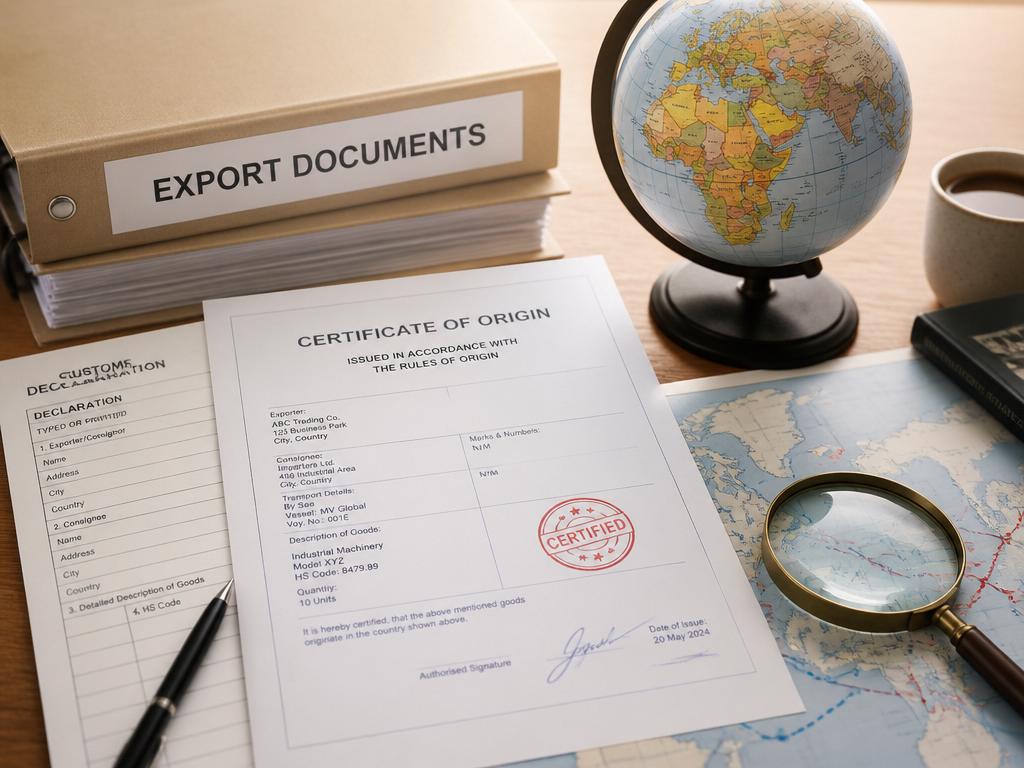
A Certificate of Origin is an international trade document that certifies the country in which the exported goods are considered to originate under the applicable rules of origin.
Depending on the country, the type of goods and the applicable trade agreement, the certificate may be issued by a Chamber of Commerce or, in some preferential trade agreements, the origin may instead be declared by the exporter under the relevant agreement.
Why Is It Important?
The country of origin can influence several aspects of international trade.
These may include:
- Customs procedures.
- Import duties and tariffs.
- Eligibility for preferential tariff treatment.
- Trade policy measures.
- Import restrictions.
- Statistical reporting.
- Origin marking requirements.
The Certificate of Origin helps customs authorities determine whether goods qualify for the treatment claimed by the importer.
Certificates of Origin Are Not Always Required
One common misconception is that every international shipment requires a Certificate of Origin.
In reality, requirements vary depending on:
- The importing country.
- The product being imported.
- Applicable free trade agreements.
- National customs regulations.
- The value of the shipment.
Some shipments require a Certificate of Origin, while others do not.
Import requirements should always be confirmed before shipment.
Preferential and Non-Preferential Origin
Certificates of Origin generally fall into two broad categories.
Non-Preferential Certificates of Origin
These certify the country of origin for general trade purposes.
They may be used for customs clearance, trade statistics, origin marking requirements or trade policy measures.
They do not automatically entitle the importer to reduced customs duties.
Preferential Proofs of Origin
Where a free trade agreement or preferential trade arrangement exists, importers may qualify for reduced or zero customs duties if the goods satisfy the applicable Rules of Origin.
The required proof differs between agreements and may take the form of:
- A movement certificate (such as EUR.1 where applicable).
- A declaration on origin.
- Another origin document specified in the relevant trade agreement.
The exact documentation depends entirely on the agreement governing the trade.
Who Issues the Certificate?
This depends on the applicable legal framework.
In many countries, Chambers of Commerce issue non-preferential Certificates of Origin.
For certain preferential trade agreements, the exporter may instead make an approved declaration of origin if the agreement allows it.
Companies should always follow the rules applicable to the destination market and the relevant trade agreement.
Common Misunderstandings
Certificates of Origin are often confused with other trade documents.
A Certificate of Origin does not:
- Prove ownership of the goods.
- Confirm product quality.
- Replace transport documents.
- Replace commercial invoices.
- Guarantee customs clearance.
It serves one primary purpose:
"To certify the origin of the goods according to the applicable origin rules."
Why Accuracy Matters
Errors relating to origin can create unnecessary complications.
Examples include:
- Customs delays.
- Requests for additional documentation.
- Incorrect duty calculations.
- Delayed release of cargo.
- Loss of preferential tariff treatment.
For this reason, exporters should ensure that origin declarations are accurate and supported by appropriate records.
Best Practices
Companies involved in international trade should:
- Confirm whether a Certificate of Origin is required.
- Identify which origin rules apply.
- Ensure commercial documentation is consistent.
- Retain supporting documentation demonstrating origin.
- Clarify origin requirements before goods are shipped.
Proper preparation helps reduce delays and supports smoother customs procedures.
Final Thoughts
Certificates of Origin remain one of the most important documents in international trade.
While the concept appears straightforward, the applicable origin rules, documentary requirements and trade agreements can vary significantly depending on the countries and products involved.
Companies that understand these requirements before shipping goods are generally better positioned to avoid unnecessary delays and ensure compliance with international trade procedures.
Need Professional Support?
International trade documentation can become complex, particularly when multiple countries, customs authorities and trade agreements are involved.
ScandAfrica helps Scandinavian companies navigate international trade by providing practical guidance, local expertise and support throughout the import and export process.
Whether you are entering a new market or managing an established supply chain, our team is ready to assist.
Frequently asked questions
Africa market entry
We plan and run the market entry itself — sequencing, counterparties, documentation and the first commercial steps in your target African market.
Africa market entry supportEvery business project is unique.
If your company is exploring opportunities in Africa or requires supplier verification, market entry support or local representation, the ScandAfrica team is ready to assist.
Contact ScandAfricaAfrica market entry — see what the engagement includes, how we work and what it costs.