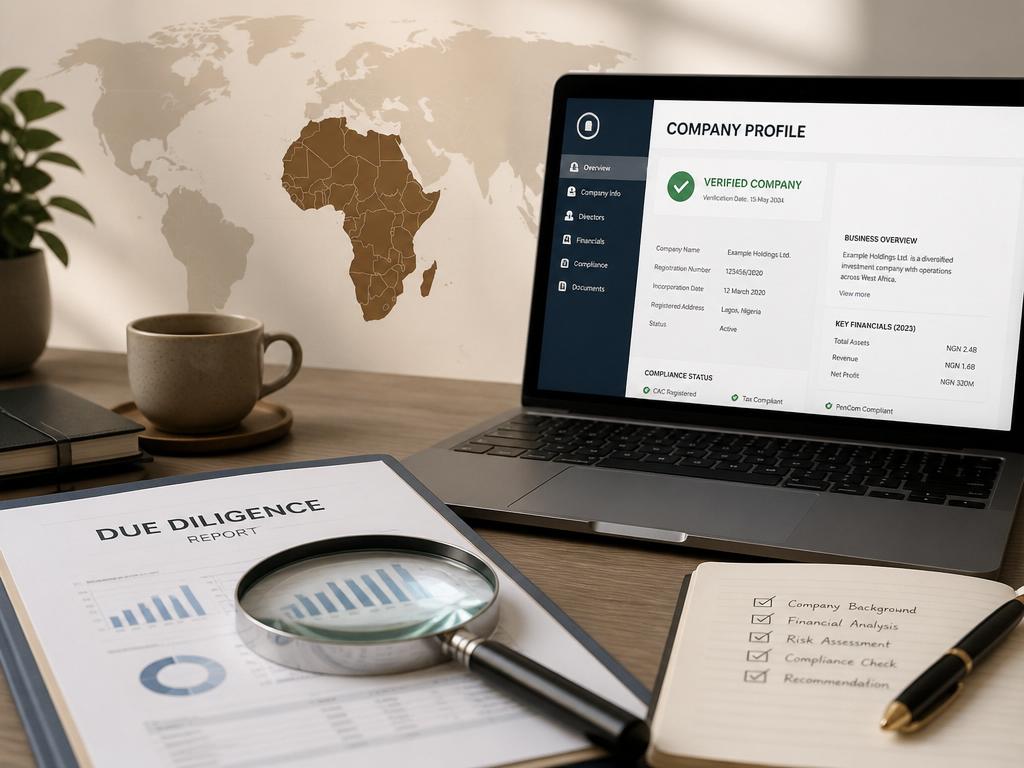
How to Verify an African Supplier: A Practical Due Diligence Guide
A layered due diligence process for Scandinavian buyers: legal identity, representatives, operations, capability, certifications, references, banking and first-transaction controls.
Finding a supplier is easy. Establishing that it legally exists, operates as claimed and can actually deliver is a different matter. An eight-point framework for verifying African suppliers before you commit.
We verify African suppliers on the ground — legal identity, ownership, capacity and site visits — before you transfer any money. supplier verification in Africa.
Finding a supplier is relatively easy. Determining whether that supplier is legitimate, capable, compliant and commercially reliable is a different matter.
For Scandinavian companies sourcing from African markets, supplier verification should not be treated as a final check before payment. It should be part of the supplier-selection process from the beginning.
The objective is not to eliminate every possible commercial risk. No verification process can guarantee future performance. The objective is to replace assumptions with evidence.
A professional supplier review should answer four fundamental questions:
- Does the company legally exist?
- Are you dealing with people authorised to represent it?
- Can the supplier actually deliver what it is offering?
- Can the commercial transaction be structured with an acceptable level of risk?
At ScandAfrica, we recommend approaching supplier verification as a layered process rather than relying on a single document, reference or database search.
The ScandAfrica 8-Point Supplier Verification Framework
1. Verify the legal entity
Start with the most basic question: does the company legally exist? Request the supplier's:
- Full registered company name
- Company registration number
- Registered address
- Tax identification number where applicable
- Date of incorporation
- Names of directors or authorised representatives where available
- Relevant business or export licences
The information should then be checked against available official company registries or competent authorities in the supplier's country.
Do not simply collect documents — verify them independently whenever possible. A professional-looking certificate of incorporation proves very little if the registration number, company name or legal status cannot be independently confirmed.
Also look for consistency. The legal entity shown in the registry should make sense when compared with:
- Quotations
- Contracts
- Invoices
- Email signatures
- Website information
- Bank account details
- Licences
- Certificates
Small differences may have innocent explanations. Significant inconsistencies require clarification before the relationship progresses.
2. Confirm who you are actually dealing with
A legitimate company can still be represented by someone who has no authority to enter into agreements on its behalf. Verify:
- The person's full name and position
- Their relationship with the registered company
- Company email address
- Telephone number
- Authority to negotiate or sign agreements
- Whether the person appears consistently across company records and communications
Where appropriate, contact the company through an independently sourced telephone number or email address rather than relying entirely on the contact information supplied by the individual you are dealing with. This becomes particularly important if payment instructions, bank accounts or contracting entities suddenly change during negotiations.
"Verify the company and verify the person. They are two separate checks."
3. Verify physical operations
A registered company is not necessarily an operating supplier. You also need evidence that the business has the facilities, personnel, equipment, inventory or production relationships necessary to fulfil the proposed transaction.
Depending on the sector, this may involve verifying:
- Office location
- Warehouse
- Factory or processing facility
- Farm or production site
- Machinery and equipment
- Storage capacity
- Quality-control procedures
- Packaging facilities
- Logistics arrangements
A live video inspection can be useful as an initial screening tool, but it should not automatically be treated as equivalent to an independent site visit. For significant transactions, physical verification may reveal things that documents cannot:
- Does the facility actually exist at the stated address?
- Is it operational?
- Does its apparent scale correspond with the volumes being offered?
- Are the people presented as employees actually present?
- Is the inventory owned by the supplier or merely accessible for presentation?
- Are quality-control processes visible in practice?
The distinction between a company that exists and a company that can deliver is one of the most important principles in supplier verification.
Where a physical visit is justified, the value depends entirely on what is actually examined on site. Our guide to what international buyers should check during a factory inspection in Africa sets out the premises, production, capacity, storage and documentation checks an inspection should cover.
4. Assess operational capability
A supplier may be completely legitimate and still be the wrong supplier for your order. This is why verification should also assess capability. Ask specific questions about:
- Production capacity
- Current available capacity
- Minimum order quantities
- Normal lead times
- Seasonal constraints
- Raw-material sourcing
- Quality-control systems
- Packaging capability
- Export documentation
- Freight arrangements
- Previous destination markets
Then test whether the answers are commercially plausible. If a relatively small operation claims it can immediately supply volumes significantly greater than its visible production or storage capacity, further investigation is justified.
Similarly, distinguish between production capacity and available capacity. A factory may technically be capable of producing 1,000 tonnes per month while already having most of that capacity committed to existing customers.
Verification should therefore examine what the supplier can realistically deliver to you, not simply the theoretical maximum capacity of the business.
5. Verify licences, certifications and compliance claims independently
Never treat the presence of a logo or PDF certificate as sufficient evidence. Where a certification is relevant to the product, identify:
- Issuing organisation
- Certificate holder
- Certificate number
- Scope
- Production location covered
- Products covered
- Issue date
- Expiry date
- Current status
Then verify the information through the issuing organisation or its official verification system where one exists. For agricultural products, for example, GLOBALG.A.P. certification status can be checked through its official Supply Chain Portal using the producer's identification number.
The same principle applies beyond agriculture: do not verify the document — verify the underlying claim.
Product requirements also differ substantially depending on what is being imported into the European Union. The European Commission's Access2Markets service provides product- and country-specific information about tariffs, rules of origin, customs procedures and import requirements.
6. Check commercial history and references
Ask the supplier about previous exports and customers. Useful questions include:
- Which countries do you currently export to?
- Which products do you export regularly?
- How long have you been exporting?
- What volumes do you normally handle?
- Can you provide references from international customers?
- Can you provide examples of previous export documentation with confidential information removed?
References should be independently validated where possible. Do not ask only whether the supplier is good. Ask specific questions:
- Were deliveries made on time?
- Did quality match specification?
- How did the supplier handle problems?
- Were documentation and export procedures handled correctly?
- Were there unexpected changes in price or payment terms?
- Would you buy from this supplier again?
A reference is much more useful when it describes actual commercial behaviour.
7. Check banking and payment integrity
Payment details deserve their own verification step. Before transferring funds, compare:
- Beneficiary name
- Registered company name
- Contracting entity
- Invoicing entity
- Country of the bank account
- Account changes during negotiations
A corporate supplier requesting payment to an unrelated personal account should trigger further investigation. The same applies when payment instructions unexpectedly change shortly before a transfer.
Verify changed payment instructions using a second communication channel. Do not rely solely on an email that contains new banking details.
For higher-value transactions, the payment structure itself should be part of the risk assessment. The appropriate method depends on the transaction, relationship, product, country and negotiating position.
"The amount of commercial trust granted should increase as evidence and transaction history increase."
8. Start by proving the transaction, not assuming it
Even excellent desktop due diligence cannot prove how a supplier will perform in a real transaction. Where commercially practical, reduce initial exposure. Options may include:
- Samples
- Independent laboratory testing
- Pilot order
- Smaller first shipment
- Pre-shipment inspection
- Clearly defined quality specifications
- Milestone-based payment structures
- Documentary payment mechanisms
The first transaction should provide information as well as goods. Did the supplier:
- Communicate professionally?
- Meet agreed deadlines?
- Produce correct documents?
- Maintain consistent quality?
- Follow agreed packaging specifications?
- Respond constructively when problems arose?
A successful supplier relationship is ultimately built on demonstrated performance.
Supplier verification red flags
No single warning sign automatically proves that a supplier is fraudulent or unsuitable. Several warning signs together, however, should increase the level of verification. Examples include:
- Company information that changes between documents
- Inability to verify legal registration
- Unexplained use of several company names
- Personal rather than corporate payment accounts
- Bank beneficiary that does not match the contracting entity
- Sudden changes to payment instructions
- Reluctance to provide registration information
- Certificates that cannot be independently verified
- Refusal to allow a facility inspection
- Inability to explain production capacity
- Unusual pressure for immediate payment
- Reluctance to provide customer references
- Prices significantly below commercially plausible levels without a convincing explanation
- Photographs or company materials that cannot be connected to the actual business
- Contradictory information from different representatives
Red flags should not automatically end a negotiation. They should determine what must be verified before the negotiation continues.
Do not confuse supplier verification with supplier selection
This distinction matters. Supplier verification asks: is the information about this supplier true? Supplier qualification asks: can the supplier meet our technical and commercial requirements? Supplier selection asks: is this the best supplier for our business?
A company can pass verification and still fail qualification. A supplier may be legally registered, financially legitimate, operating from a real facility and experienced in exporting — but unable to meet your required volume, specification, lead time, certification, price or traceability requirements.
Good procurement requires all three stages.
Sanctions and counterparty screening
Depending on the transaction, companies should also determine whether relevant sanctions or other counterparty restrictions apply. The European Commission maintains information on EU sanctions regimes, including access to the EU Sanctions Map and the consolidated list of persons, groups and organisations subject to EU financial sanctions.
This is a separate exercise from ordinary supplier verification and may require specialist legal or compliance advice depending on the transaction.
A practical supplier verification checklist
Before approving a new supplier, you should be able to answer the following.
Legal identity
- Is the registered company independently verified?
- Does the registration number match?
- Is the company currently active?
- Is the address consistent?
- Have relevant licences been checked?
People
- Have the key representatives been identified?
- Are they connected to the registered company?
- Is signing authority clear?
Operations
- Has the operating location been verified?
- Can the supplier demonstrate relevant production or supply capability?
- Is the stated capacity commercially plausible?
- Are quality-control processes understood?
Certifications and compliance
- Have relevant certificates been independently validated?
- Do they cover the correct legal entity?
- Do they cover the relevant product and facility?
- Are they currently valid?
Commercial history
- Has export experience been assessed?
- Have customer references been checked?
- Has previous transaction evidence been reviewed where appropriate?
Payment
- Does the beneficiary match the contracting entity?
- Have bank details been independently confirmed?
- Is the payment structure proportionate to the risk?
Transaction
- Have samples or specifications been approved?
- Is inspection required?
- Is the first commercial exposure appropriately limited?
- Are quality, delivery and documentation requirements written into the agreement?
Desktop verification vs on-site verification
Not every transaction requires a physical inspection. A desktop verification can often establish:
- Corporate identity
- Registration status
- Key individuals
- Available ownership information
- Certifications
- Online presence
- References
- Reported export history
- Sanctions indicators
- Inconsistencies in documentation
An on-site verification adds another layer. It can help establish:
- Whether the stated premises exist
- Whether operations are active
- Visible capacity
- Equipment and facilities
- Inventory or production activity
- Quality-control procedures
- Management presence
- Practical readiness for the proposed transaction
The appropriate level of verification should reflect the potential financial and operational exposure.
If you already have a specific supplier in front of you and simply need the checks in order, use the shorter supplier due diligence checklist for buyers in Africa, which follows the same logic in decision order from first contact to first payment.
Why local verification can matter
Supplier verification becomes more difficult when the buyer is thousands of kilometres away. Language, administrative systems, local business practices, physical distance and limited access to local records can make apparently simple questions harder to answer.
This is where local capability becomes valuable. A local representative can make calls, verify addresses, visit facilities, speak directly with management and compare what exists on the ground with what has been presented to the buyer.
The objective is not to replace the buyer's procurement process. It is to provide better evidence for the buyer's decision.
How ScandAfrica supports supplier verification
ScandAfrica assists Scandinavian and European companies that need greater confidence before entering into commercial relationships with African suppliers. Depending on the assignment, support can include:
- Company background verification
- Document and identity review
- Supplier screening
- Local enquiries
- Verification of physical presence
- Management contact
- Facility visits
- Photographic documentation
- Operational observations
- Supplier interviews
- Identification of inconsistencies and red flags
- Structured findings for management review
Supplier verification is not a guarantee of future performance, financial solvency or contractual compliance. It is a structured process designed to provide better information before important commercial decisions are made.
Verification ends when the supplier is approved. What happens afterwards is a separate discipline: managing African suppliers over the long term covers specifications, delivery performance, escalation and performance reviews once the relationship is live.
Make better decisions before you commit
The best time to discover a supplier problem is before the first major payment, not after the first failed shipment.
If your company is evaluating a supplier, manufacturer, exporter or commercial partner in Africa, ScandAfrica can provide independent local verification and structured due diligence support.
Frequently asked questions
Supplier verification
We verify African suppliers on the ground — legal identity, ownership, capacity and site visits — before you transfer any money.
supplier verification in AfricaNeed to verify a potential African supplier?
Verify before you commit. ScandAfrica combines desktop due diligence with local verification and on-site assessments where required.